Stephen DeCasien
December 12, 2025
In exploring the ancient world, we are reminded that distant civilizations were often not so different from one another. Whether in Greece or China, the challenges of defense, trade, and power led societies to place immense value on naval strength, on par with their armies and fortifications. One compelling example of this cross-cultural comparison can be seen in the study of two fascinating ancient warships: the Greek τριήρης (triḗrēs), commonly known by its Latinized name, “trireme,” and the Chinese 突冒 (tūmào, in Pinyin). Despite originating in distinct cultural and geographic contexts, these vessels are strikingly similar. Both were designed around a core principle: the use of a reinforced bow to ram and disable other ships. This similarity does not stem from direct contact or shared technological knowledge, but rather represents an exciting instance of parallel evolution.
The names of these vessels serve as linguistic artifacts revealing an aspect of their purpose or structure. The trireme emerged as a dominant naval vessel in the Mediterranean during the Greco-Persian Wars (492–449 BCE). The Greek τριήρης (triḗrēs) breaks down into “tri-” (three) and “-ḗrēs” (oared/rowed), a somewhat ambiguous term that scholars tend to agree refers to the number of oarsmen separated into three distinct rowing levels. The tūmào (突冒) was reportedly employed during the reign of King Helü of the Wu Kingdom (吴王阖闾, r. 514–496 BCE), a period characterized by significant military and naval innovation in ancient China. The name tūmào (突冒), composed of the Chinese characters “突” (tū), meaning “sudden” or “to penetrate,” and “冒” (mào), meaning “risk” or “boldness,” suggests a vessel intended for swift, aggressive assaults against enemy ships.
Unfortunately, no trireme or tūmào has survived in the archaeological record. While limited iconographic evidence exists for the trireme, none has yet been securely identified for the tūmào, making textual sources the most reliable accounts for both vessels. The origin of the trireme remains contested, with ancient historians offering conflicting narratives. Thucydides is often cited for attributing its development to the Corinthians in the late eighth century BCE (Thuc. 1.13.2–4), though this claim has been widely debated.
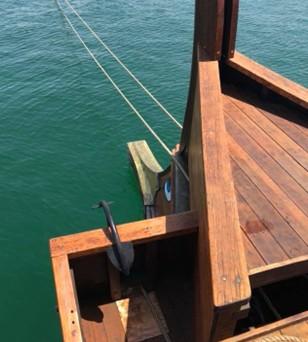
In response to these uncertainties, a landmark experimental archaeology project led by John S. Morrison and his colleagues sought to reconstruct a trireme based on ancient sources such as the Lenormant Relief. This endeavor culminated in the construction of the Olympias, a full-scale replica that has provided information on trireme construction, speed, maneuverability, and crew organization. In Western academia, the trireme has often been portrayed as both a remarkable technological innovation and a symbol of democratic power, a narrative that has significantly shaped scholarly discourse and interpretation for decades.
Perhaps the best-known reference to the tūmào appears in the Taiping Yulan (太平御覽), an encyclopedic text compiled between 977 and 983 CE during the Song Dynasty. This source cites the earlier Yue Jue Shu (越绝书), likely composed in the first or second century CE during the Eastern Han Dynasty. Ancient Chinese texts mention the tūmào among several specialized warships during a discussion of the Wu Kingdom’s naval preparations between the previously mentioned King Helü and his advisor. Unlike the trireme, the tūmào is mentioned only sparingly, making its structure and role in naval warfare difficult to reconstruct.
The tūmào has received relatively limited attention in Western scholarship. Joseph Needham’s influential work, Science and Civilisation in China (1971), offers an early overview of Chinese maritime technology and describes the tūmào as a blunt-prowed ship. He was the first to draw comparisons between the tūmào and Mediterranean vessels, noting their shared functional purpose. While foundational, Needham’s analysis was limited by the lack of both textual and comparative sources available at the time. For example, he mistakenly refers to the tūmào (突冒) as thu-wei (突胃), or “stomach-striker,” a misreading resulting from a textual corruption in extant copies of the Taiping Yulan. In modern Chinese scholarship, the tūmào is frequently discussed alongside other potential Chinese ramming vessels, from the Han to Song Dynasties.
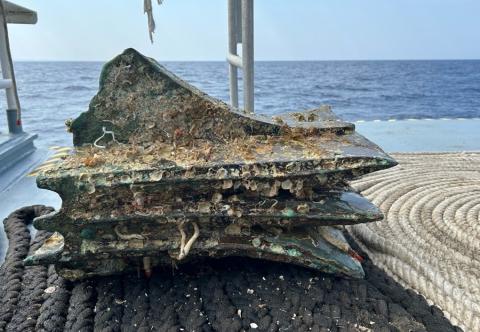
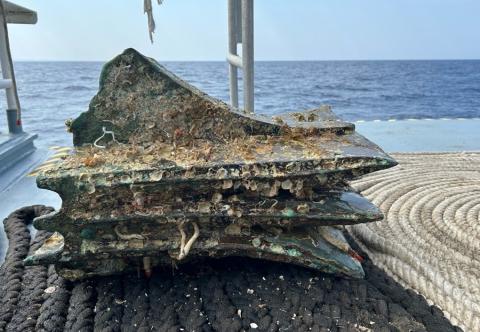
Ancient sources indicate that triremes were manned by around 170 oarsmen, who served as the vessel’s primary source of propulsion. As previously mentioned, these rowers were arranged in three tiers on each side of the vessel, providing the speed and agility that made the trireme such an effective warship. At the bow of the ship was its principal weapon, the ἔμβολον (embolon), a bronze-cast ram consisting of three blades. Positioned at or just below the waterline, the ram was designed to puncture the wooden hulls of enemy ships, causing them to swamp or sink. In naval combat, triremes employed tactics such as the διέκπλους (diekplous), a breakthrough maneuver, and the περίπλους (periplous), a flanking technique, to outmaneuver opponents. Triremes operated effectively in both open-sea battles and confined harbor engagements.
One major distinction between Greek and Chinese warships lies in their hull design. Greek ships were constructed with wineglass-shaped hulls and sturdy keels, which could be naturally extended into a metal clad cutwater used for striking enemy vessels. Triremes were built from durable woods such as pine, fir, and oak. Their hulls were carefully assembled using mortise-and-tenon joints, a method that ensured both strength and flexibility. In contrast, Chinese warships were typically flat-bottomed and lacked deep keels, making them more suited to shallow rivers and coastal waters. Though evidence for ancient Chinese ships is sparse, the tūmào was likely built with edge-joined planks, but not in the tight-fitting mortise-and-tenon style used by Mediterranean ships. Instead, the planks were perhaps sewn (or stitched) or were joined with loose tenons set into shallow edge grooves, and reinforced with metal nails. It is unclear if the tūmào was paddled or rowed, though rowing would provide more power for a ramming strike, albeit if the intention was damage, not boarding.
Compared to the trireme, less is known about the tactical use of the tūmào, but some information can be inferred from its textual mentions. It is likely that the tūmào featured a metal-capped prow, although its design would have been quite different from the Mediterranean ram. Its role in battle, as suggested in a dialogue between King Helü and his advisor, indicates that it was not the primary combat vessel. In that conversation, five distinct ship types are mentioned, each corresponding to a specific role and modeled after land-based weaponry or tactics. The tūmào is likened to a 衝車 (chōng chē), a battering ram, suggesting that its role was to collide with enemy vessels and disrupt their formations. Rather than serving as a semi-independent “ramming torpedo” like the trireme, the tūmào perhaps functioned as an auxiliary craft supporting larger warships in riverine environments.
A deceptively simple question arises: why ramming? And why did this tactic appear in multiple cultures around the same time? Ramming warfare seems to arise during times of great upheaval, such as the tumultuous Spring and Autumn period (roughly, 770–481 BCE) in China and the Greco-Persian and Peloponnesian Wars in Greece. Both ancient Greek and Chinese civilizations possessed the technological capabilities, such as advanced shipbuilding techniques and metal casting, to create vessels specifically designed for ramming. But still, why choose this method?
Is ramming merely a simplistic tactic, a way to launch your ship at the enemy in hopes of disrupting and defeating them? Or does it reflect something deeper about the societies that employed it? The Athenian trireme, for example, was said to be rowed by “free” working citizens. This might point to a tactical preference for swift and decisive engagements, battles meant to conclude quickly so the rowers could return home. Was the Chinese tūmào similar, or did it embody a more communal ideal of warfare, one centered on coordination and service to a shared purpose?
Currently, the author of this blog post and several Chinese colleagues are undertaking a more thorough cross-cultural investigation of these early Mediterranean and Chinese ramming warships. Studying these vessels together is useful in several ways. It helps reveal details that would likely go unnoticed if each case were examined in isolation. For example, it draws attention to the different construction methods, tactical aims, and environmental settings that shaped each type of vessel. It also encourages us to examine whether distant societies sometimes respond to similar problems in comparable ways and what that might suggest about shared patterns in human decision-making. Finally, comparing these ships pushes us to reconsider the analytical categories we regularly rely on, since each tradition exposes assumptions in the other and supports a more careful and adaptable understanding of ancient naval warfare.
Authors

|