Vanessa Stovall
December 8, 2025
What does it mean to use the stage to educate oneself about tragic texts?
This is a question that I’m eager to continue exploring while I direct the next production for the Committee for Ancient and Modern Performance at the upcoming Society for Classical Studies Annual Meeting in San Francisco in January. Tantalids: take ii is an English-language translation that combines sections of two ancient tragedies–two thirds of Aeschylus’ Agamemnon and one third of Seneca’s Thyestes. Previously staged at the University of Vermont in April 2024, Tantalids tells the overlapping tales of the House of Atreus, as the ghost of Tantalus is summoned to watch the unfolding tragedies of the past and present (and future). The production will take place on January 8th from 7:30-9:30pm in the Yosemite Ballroom, including a talkback with the cast and crew.
Background of Tantalids
The idea for the production was first conceived in January 2023 between me and Jeannette Chien, who was an undergraduate and, later, graduate student at UVM. Jeannette had been eager to stage the Agamemnon in the department, and I had been working on musical compositions for the Barnard-Columbia Ancient Drama Group production of Helenephoria, a mash-up of Aristophanes’ Women at the Thesmophoria with a portion of Euripides’ Helen (directed by Izzy Levy and Charles Pletcher). I was interested in combining a Greek tragedy with a Latin tragedy, because we always did English-language productions at UVM, which would help aid in cohesively bringing together texts of separate languages (whereas Helenephoria was performed in Greek and relied on the intertextual links between the two plays for cohesion). I suggested the Thyestes would be an interesting insertion, since Cassandra’s scene in the Agamemnon where she ruminates on the past would make an easy segue into the other play, and because it would enable us to use double-casting with the characters Agamemnon/Atreus and Aegisthus/Thyestes to cohesively stitch together the two dramatic narratives.
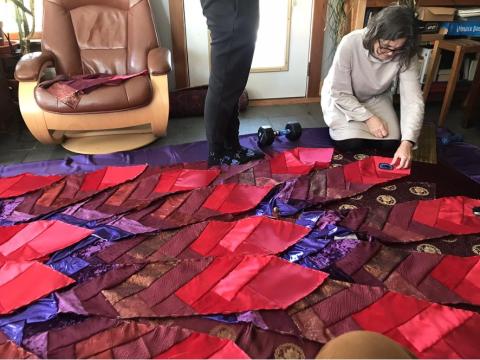
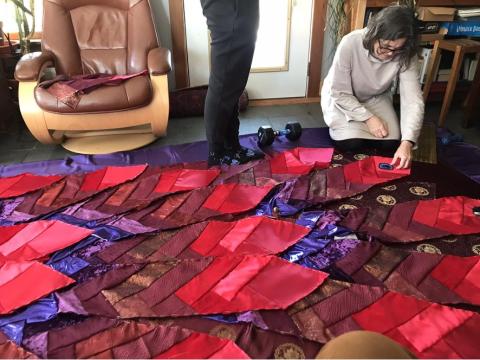
For the original production, Jeannette directed, Abi Mason produced (returning again for take ii), and I wrote an original score for several of the odes from the two plays. The three of us together translated all of the Greek and Latin, with additional help from Alex Seiler, who portrayed Clytemnestra in the show (also returning in the chorus for take ii). Many members of the UVM Classics graduate program came together for the production, especially our professors Jacques Bailly and John Franklin in the roles of Tantalus and the Watchman, respectively, and graduate student Sunshine Alvarrez de Silva as Cassandra. One of the most spectacular and unexpected collaborations came from artist Leslyn Hall, wife of Dr. Bailly, who helped make the main prop of the show, an elaborate quilt designed like a peacock tail in red and purple to represent the textile wealth of the House of Atreus.
As we staged Tantalids, I also had the opportunity to design and teach my own humanities course at UVM in Spring 2024: Ancient Tragedy/Modern Horror, enabled from teaching mentorship and syllabus help from professors Angeline Chiu and Penny Evans. In class, we explored multiple fascinating connections and shared tropes of the genres of tragedy and horror. For our first month, we looked at the Visuals across the genres, from deadly tubs to spiders to axes; for the second month, we identified similarities around Audio, considering scream queens, messenger speeches, soundtracking, and horror choruses; and the third month, we analyzed “Negative” Emotions that anchor both tragedy and horror, especially anxiety, fear, and disgust. In class, my students had the option to engage with different forms of contemporary horror media to pair with readings from ancient tragedy (the bathtub, in particular, sparked conversation from Psycho to Saltburn), as well as some of the scholarship analyzing tragedy through a horror lens (a favorite was Rosa Andújar’s chapter in Queer Euripides on the monstrous soundtrack of Euripides’ Phoenician Women). My experience teaching that class was extremely influential over the second version of the production that I’m staging for CAMP, especially in figuring out different ways to evoke horror using the technē of the theater.
Production Changes for CAMP
Since we have a large conference ballroom instead of a black box theater, there are quite a few changes to the staging of Tantalids: take ii that have shifted for the CAMP production. One of the key differences is the lighting–the original production dealt quite a bit with projection (both supertitles as well as the beacons) which we’ve had to cut due to costs, and so instead we are having the chorus fill the role of much of the lighting throughout the production with flashlights. There will also be a few lamps and some fairy lights, as well as a hand mirror for Clytemnestra to direct reflections during her beacon speech. (My latest project is figuring out the different light variations that glow sticks can create to mark off boundaries of the space).
A further consideration is the unique audience: due to Tantalids being hosted at the SCS, there is the issue of having an audience who knows all too well how both of these plays end, and so I’ve done a little bit of interpolation from some other ancient authors–notably, Homer, Sophocles, and Euripides–interspersed throughout the Aeschylean-Senecan corpus, in an attempt to make something of a surprise ending for this second take on the production. I’m curious as to how many scholars might pick up on the foreshadowing (and am eager to discuss such in the talkback after the show on Thursday evening).
Touring Tantalids
An interest of mine that developed through doing the first show (and especially through teaching ATMH) was to have Tantalids be a touring production. While the circumstances of the world have changed quite a bit from when I had this idea in early 2024, I still think that there is use and utility in continuing to put on this production and attempting new ways to bring together ancient texts. CAMP offers the perfect venue and audience to discuss how such a prospect might be feasible. And while I would be happy to direct the play again, I think it would be far more interesting if other directors took it to their own institutions, in order to pull out new and different themes from the plays that they wish to explore for their own unique audiences. There is great potential in combining two plays, and endless varieties towards doing it; part of me is fascinated by what Tantalids would look like with the ratios of the plays flipped–one third of the Agamemnon with two thirds of the Thyestes–or with different double-castings, such as Clytemnestra/Furia.
While the quip from Aeschylus in Aristophanes’ Frogs about how tragedy educates adults in the same manner that teachers educate children is said in comedic debate, I do believe that it bears a vital truth—i.e., that tragedy is full of lessons for all of us to learn from through the heightened and exaggerated nature of its performance. I also believe that tragedy must be experienced off the page in order to capture these lessons fully. At the same time, there is the limitation that all of our tragedies are fragmentary–even the mostly-complete Oresteia is missing its satyr-play Proteus. Our experience of the true tragic form will always be partial as we attempt to seek what its whole might have been. But if fragments are all we have, then perhaps that is what we should draw inspiration from in our work, as I’ve attempted to do by finding the similarities across two plays and taking my own fragments from them to create something new in the tragic form. I don’t know if I’ll ever make my way up to directing full tetralogies, but with each of my productions I aim to bring something of the scope of tragic competition into a single play, and to present a plot that is constantly being understood in the context of other plays that it vies with in terms of mythological interpretation.
And so Tantalids: take ii is somewhat haunted, and not just by its titular ghost. The primarily Aeschylean text goes through a similar process to Tantalus, as it is abruptly jerked from the poetic past (Homer), tragic present (Sophocles and Euripides), and dramatic future (Seneca) in its attempts to find something of a finish from inherent incompletion. While I do not want to share many details, as they will ruin some of the surprises, I would like to emphasize that this production is designed to help bring forth the horror elements of the texts–plays of spousal slaughter and a father eating his children–which is something to consider for any wishing to attend the production. And so, as the days grow shorter, and the clock ticks down to January 8th, and I practice clicking on a flashlight in time to the new soundtrack, there’s only one question left to ask…
Are you afraid of the dark?
Authors

|