Ava Roy, James Ker, and Nina Papathanasopoulou
November 6, 2025
As we look ahead to the Odyssea event at the SCS and AIA Annual Meeting in San Francisco, co-organizers James Ker and Nina Papathanasopoulou spoke to Ava Roy, Artistic Director of We Players, and discussed how this piece began its 13-year journey from a sailboat in San Francisco Bay to Angel Island to the San Francisco Hilton Union Square.
According to Roy, one of the joys of working with old texts is that she considers them “invincible” and “able to support,” as she says, “an endless stream of interpretations.” Each time we approach these texts, Roy believes, our response is unique, shaped by the moment, the circumstances, and the context. The ancient texts are made forever new through new retellings. Inspired by the opportunity of presenting another new retelling of the Odyssey, this time in 2026 and among scholars and students of the ancient world, Roy is crafting a new version, titled Odyssea, specifically for the SCS/AIA Meeting. She shares with us her thoughts on the creative process and her early motivations for wanting to stage the Odyssey:
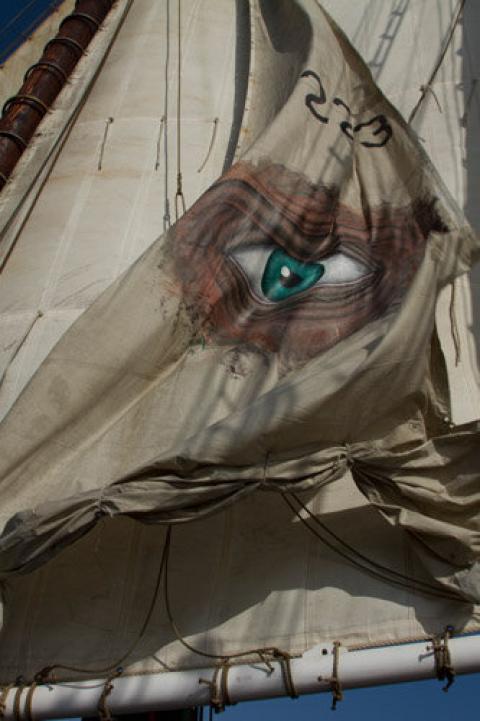
My initial desire to stage a version of The Odyssey came from the sea itself. I had been sailing along the Pacific coast of Mexico and then completed an ocean-crossing from Southern Mexico to Hawaii, a 36-day passage of some 3600 nautical miles, during which there was lots of time to contemplate the wine-dark sea. Upon my return to the San Francisco Bay Area, I became acquainted with the historic ships at SF Maritime National Historical Park, one of which actively sails—versus the other ships that remain dockside as floating museums. The sailing ship was the scow schooner Alma, a flat-bottomed sailboat, meaning she does not heel over (lean off to one side) the way most monohulls do. A flat-bottomed sailboat? A floating stage perhaps? Captain Jason of the SV Alma, who became our “Captain Jason of the Almanauts,” was amenable to the wild idea that his crew could become actors and my actors could become crew. The premise was quite simple: We are all sailors upon these vast seas of life, passing the time and building connections with each other through telling stories. Isn’t that at the very root of storytelling? Of the oral tradition? To share time and space together with fellow humans, words weaving through us, stitching us together through shared experience, real or imaginary.
Through the telling of stories, we celebrate the past and imagine the future while enriching our present moment. Perhaps we embellish the details, twist the tone, warp the origins or interpretations to our liking. Perhaps we create new worlds, new meanings, new mythologies through our exaggerations or omissions. Regardless of the veracity, or the divergent perspectives from one storyteller to another, this practice of spending time together in story and song is ancient, inevitable, essential. We’ve been doing it in some form or another since painting with clay and charcoal, and even shadows, upon cave walls. We’ve been gathering in circles around fires since the first fires. And sometimes, through the telling, through song, through the simple ceremony of gathering, we might awaken the inner muse of a story. And when we awaken the Muse, her energy rises up and carries both the orator and listeners away on her mysterious currents, transforming our experience of both time and place.
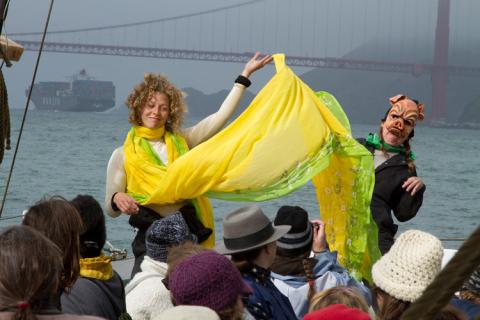
Roy and her small team drew on “athletic physicality, muppet-level hijinks and humor, and the intimacy of the playing space” to “investigate” The Odyssey. All of this happened on board the boat, with the audience seated in the center while the actors “cavorted and tumbled around them.” Roy explains:
As the stage sailed around the SF Bay, we brought the audience into the sensory experience of the sea, with the salt spray on their skin, the wind against their faces, the slosh and slap of the water against the hull, the feel of rope in their hands as they helped us haul on lines. All of this provided opportunities to dive deeper into an ancient past, through direct physical contact with some of the same materials Odysseus and his crew would have shared: wood, water, rope, salt, sun, clouds.
Our sailing production in 2011 also served to deepen my interest in this epic and fed a desire to expand and complexify my telling of it. Thus began the development of a six-hour performance, The Odyssey on Angel Island State Park (2012), in which audiences took boats from multiple cities to land on the 800-acre island-stage in the middle of the SF Bay. Upon off-boarding on the shores of Ayala Cove, the audience met Odysseus’ son Telemachus, with whom they traveled around the island, always in the wake of his father’s footsteps. In this version, I began to really lean into the loneliness and isolation of Penelope, who was literally tethered to her house with a rope of her own making.
Throughout the island-wide adventure, we would sometimes catch glimpses of Penelope, hauling a huge rope in the distance, or wandering past the gaping windows of the “1000-Man Barracks” (a huge WWII era barracks, long abandoned and crumbling in decay). I started leaning into the fickleness of the gods, who were both larger than life as they perched on a mini Mount Olympus on the top of the old rock-quarry cliffs, and who were comically petty and cartoonlike. I wanted to create real stakes for the audience, so they were drawn into the worlds of the Wind King, the Lotus Eaters, the Cyclops’ cave, Circe’s realm, the Underworld, Calypso’s island, and in each situation had to work together to placate, escape, trick, or persuade in order to continue the journey. Eventually, upon return to Ithaca, Telemachus found Odysseus had already been there, destroyed the suitors, and left again. The Wanderer was already wandering anew, never content to tend to hearth and home.
Although an important aspect of the immersive production was its power to “centralize each audience member” as a crew member and “a traveler on their own odyssey,” Roy also sought to “layer in questions” and to “complicate the picture of Odysseus the hero,” as well as the heroism of Telemachus—and of the home-bound Penelope: “She does not make an epic voyage full of monsters and gods, but remains tied to home. Yet she experiences a veritable invasion of monsters and must seek the strength of the divine within, to protect herself and remain resolute in her self-sufficiency.”
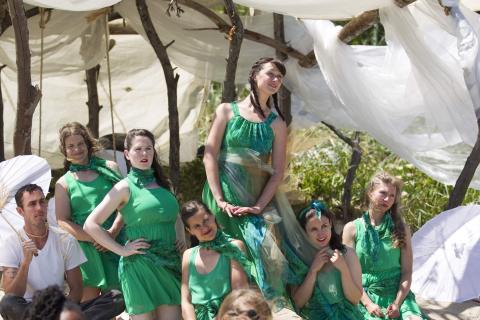
As Roy and We Players prepare to revisit their own theatrical odyssey in 2026, the revival gives a new edge to the idea that “the oldest stories are made forever new through the telling”:
That’s just what we’d like to celebrate with this new version we’re building specifically for the Society for Classical Studies and inspired by the invitation to do so. To approach a familiar set of stories, some 13 years since my last visit to these strange islands in the wine-dark sea, and ask: What’s here now? What do I notice? What do I feel? What questions arise in me today? What feels important this time round? These are some of the questions we will engage with in our upcoming rehearsal process. And I look forward to that process of discovery!
My approach will be to playfully and joyfully uplift the heroes of modern classics—the scholars who devote their intellect and talent to keeping these stories and histories alive forever through their courageous acts of teaching, translating, studying, archiving, interpreting, preserving, persevering. Our cast will be all female. While I’ve always been gender fluid in my casting over the 25 years of We Players, at present I am particularly committed to centralizing female and nonbinary bodies as a celebratory act of resistance and modeling possibility. May there be a time when this is neither unusual nor feels so necessary. We will be working with Emily Wilson’s new translation, a great honor and delight that will provide an infusion of fresh perspective and which lends itself brilliantly to my team’s feminist and anti-colonialist sensibilities. Wilson’s translation is luscious with imagery and the poetry carries me swiftly across the pages. Her word-choice throughout often emphasizes that the man of wiles is also a man of lies, that stratagems can also be tricks, that the brave and dauntless leader also boasts a swelling ego and destructive hubris. He is both, all, and. Indeed, the story of a complicated man.
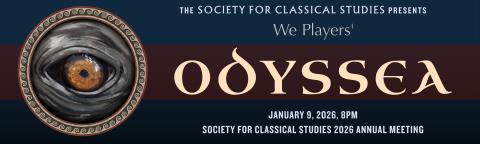
We Players' Odyssea will be performed on Friday, January 9, 2026 from 8:00 PM – 10:00 PM in the Yosemite Ballroom at the Hilton San Francisco Union Square. For more information and to reserve your tickets visit:
https://www.classicalstudies.org/annual-meeting/we-players-odyssea
Authors

|

|

|